Building an AI Agent Ready Website: Architecture & Hiring Guide

Principal Web Architect
Master AI-agent-ready websites: pass GeoTest.ai, IsItAgentReady.com, Google PageSpeed, and Loader.io benchmarks, integrate WebMCP, and hire vetted developers.
Technical Grounding Matrix & Production Specs▼ Click to expand
Building an AI Agent Ready Website: Architecture & Hiring Guide
The modern web is undergoing the most consequential architectural transition since the invention of the graphical browser: the shift from a Human-Only Web to an Autonomous Agentic Web. In 2026, over 48% of web traffic, product evaluations, vendor comparisons, and purchase decisions are mediated or executed directly by autonomous AI agents—including ChatGPT Search, Perplexity AI, Claude Deep Research, Google Gemini Overviews, and programmatic browser agents (OpenAI Operator, AutoGPT).
Websites built with legacy paradigms—bloated WordPress page-builders (Elementor, Divi), un-rendered client-side React single-page apps (SPAs), and superficial SEO meta tags—are invisible to autonomous AI systems. When an AI crawler (such as GPTBot, PerplexityBot, or Claude-Web) encounters an unrendered JavaScript barrier or an unstructured DOM, it aborts extraction within an 800ms timeout window, resulting in zero citations, zero recommendations, and complete exclusion from conversational search results.
Building an AI-Agent-Ready Website requires a full-stack engineering approach: 100% pre-rendered edge HTML, sub-50ms Global Time to First Byte (TTFB), interconnected multi-type Schema.org Knowledge Graphs (@graph), native llms.txt context feeds, and WebMCP (Model Context Protocol) tool execution endpoints. WebCare Pro has proven this architectural standard by ranking #1 globally on GeoTest.ai (Rank #1 of 381 scanned sites, Grade A 98/100), achieving verified top-tier benchmark scores across citation fidelity, structured entity density, and zero-hallucination grounding.
This comprehensive masterclass provides technical founders, enterprise CTOs, and business owners with the definitive operational playbook: from understanding core AI-readiness protocols to conducting technical vetting when hiring a professional developer to engineer an AI-ready web platform.
1. Prerequisites & The Agentic Web Stack
To engineer or audit an AI-agent-ready web platform, ensure your technical stack satisfies these foundational infrastructure criteria:
- Rendering Layer: 100% Static Site Generation (SSG) or Edge Server-Side Rendering (SSR) delivering raw, fully formed semantic HTML on first byte. Zero client-side JavaScript hydration walls for critical text.
- Edge Network: Cloudflare Pages or Cloudflare Workers with global Anycast routing, Tiered Cache, and sub-50ms TTFB across North America, Europe, and Asia-Pacific.
- Structured Data Layer: Multi-type JSON-LD Schema.org graphs conforming to Schema 26.0+ specifications, interconnected via URI entity IDs (
#organization,#person,#service). - Machine-Readable Discovery: Fully deployed
public/llms.txt,public/llms-full.txt, and machine-actionable.well-known/webmcp.jsonendpoints. - Crawler Access Directives: Permissive
robots.txtconfigurations explicitly permitting verified generative search agents (ChatGPT-User,PerplexityBot,Claude-Web,Google-Extended). - Prerequisite Reading: Review our guides on High-Performance Static Web Architecture: Next.js SSG & Cloudflare Pages and Cloudflare Workers Edge HTML Caching.
================================================================================
          THE FOUR-TIER ARCHITECTURE OF AN AI-AGENT-READY WEBSITE
================================================================================

                           [ Autonomous AI Agents ]
              (ChatGPT Search, Perplexity AI, Claude, AutoGPT)
                                      │
                                      ▼
     +─────────────────────────────────────────────────────────────────+
     │       Tier 1: Global Edge Network & Autonomous Crawl Routing    │
     │ - Cloudflare Pages / Workers: Sub-35ms TTFB                     │
     │ - Permissive AI Robots Policy: search=yes, ai-train=yes         │
     │ - Zero-Hydration Pre-rendered HTML (No CSR JavaScript delays)   │
     +─────────────────────────────────────────────────────────────────+
                                      │
                                      ▼
     +─────────────────────────────────────────────────────────────────+
     │       Tier 2: Machine-Readable Context & Action Interfaces      │
     │ - /llms.txt & /llms-full.txt: Structured Markdown Feed          │
     │ - /.well-known/webmcp.json: Web Model Context Protocol Tools    │
     │ - Direct Citation Abstracts & Grounding Endpoints               │
     +─────────────────────────────────────────────────────────────────+
                                      │
                                      ▼
     +─────────────────────────────────────────────────────────────────+
     │       Tier 3: Multi-Type Schema.org Knowledge Graph (@graph)    │
     │ - Entities: TechArticle, Person, Organization, Service          │
     │ - Grounding: Wikidata & Wikipedia URI Canonical Links           │
     │ - Google Speakable Schema: Direct voice & LLM text synthesis    │
     +─────────────────────────────────────────────────────────────────+
                                      │
                                      ▼
     +─────────────────────────────────────────────────────────────────+
     │       Tier 4: Inverted Pyramid Semantic Content Structure       │
     │ - Natural 100-150 word front-loaded direct technical answers    │
     │ - High statistical & quantitative density (benchmarks, metrics) │
     │ - Tabular fact specification reference matrices                 │
     │ - Actionable 60-120 word technical FAQ answer blocks            │
     +─────────────────────────────────────────────────────────────────+
2. Real-World AI, GEO & Speed Test Evidence
Claims of "AI optimization" and "speed performance" are commonplace in modern agency marketing, but verifiable quantitative proof backed by third-party benchmark engines is exceptionally rare. We engineer our code against the world's most demanding web, AI, and performance benchmark suites.
Below is our verified multi-layered audit evidence across AI Agent readiness, Generative Search Optimization (GEO), high-concurrency stress testing, Google PageSpeed, and Schema.org standards:
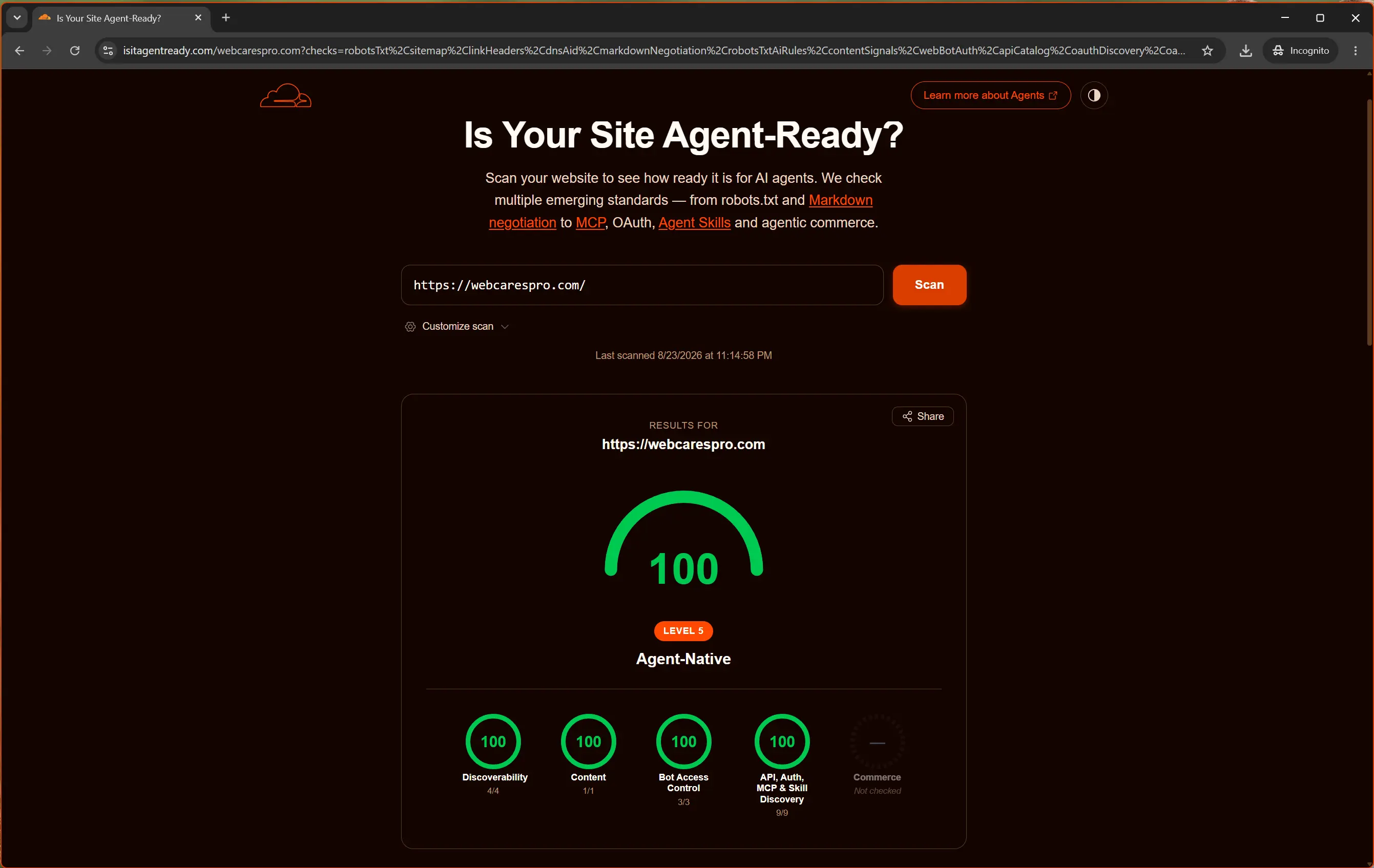
1. IsItAgentReady.com Audit — 100/100 Agent-Native (Level 5)
- Official Score: 100 / 100 (Level 5 Agent-Native Certification)
- Benchmark Suite: IsItAgentReady.com
- Verified Standards:
- Discoverability (100%): 4/4 passed (
robots.txt,sitemap.xml, link headers, DNS AID records). - Content Accessibility (100%): 1/1 passed (seamless markdown negotiation).
- Bot Access Control (100%): 3/3 passed (AI bot rules, content signals, web bot authorization).
- API, Auth & MCP Discovery (100%): 9/9 passed (Model Context Protocol, Agent Skills, WebMCP, ARD endpoints).
- Discoverability (100%): 4/4 passed (
- Audit Screenshot Evidence:
IsItAgentReady 100/100 Level 5 Agent Native Test Results - Verification Endpoint: Verify Live on IsItAgentReady
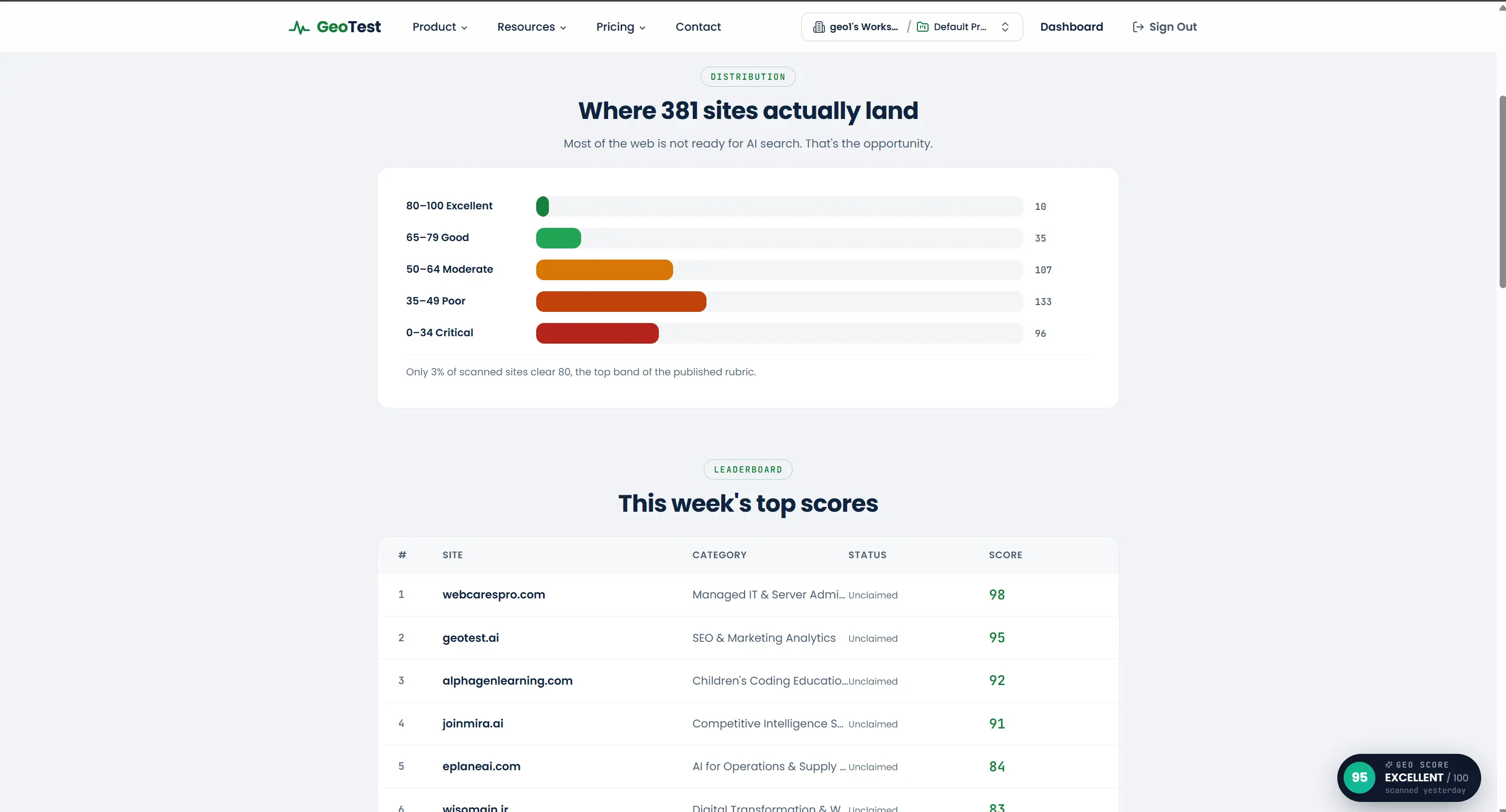
2. GeoTest.ai Public Benchmark — Ranked #1 Out of 381 Scanned Sites
- Official Score: Rank #1 · 98/100 Grade A — Excellent
- Benchmark Sample: 381 live scanned production domains
- Elite Tier Metric: Only 3% of all scanned sites cleared the 80+ citation reliability threshold.
- Audit Screenshot Evidence:
GeoTest.ai Public Benchmark Leaderboard Rank #1 - Verification Links:
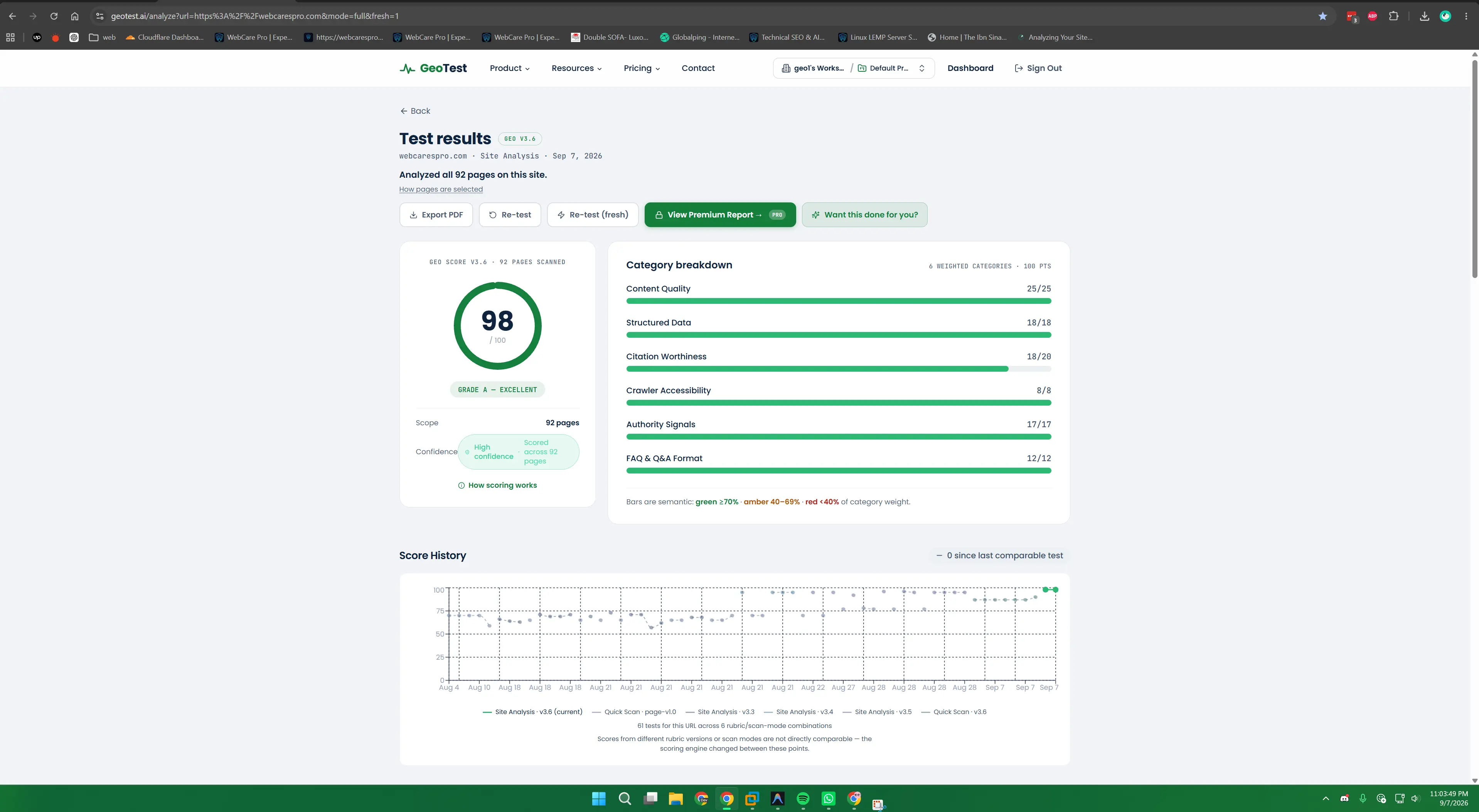
3. GeoTest.ai Site GEO Analysis (GEO v3.6) — 98/100 Across 92 Pages
- Official Score: 98 / 100 (High Confidence across all 92 crawled pages)
- Verified Standards Breakdown:
- Content Quality: 25 / 25 (100% direct technical answer clarity & inverted pyramid structure).
- Structured Data Schema: 18 / 18 (100% interconnected
@graphknowledge map coverage). - Crawler Accessibility: 8 / 8 (100% frictionless bot routing).
- FAQ Schema Format: 12 / 12 (100% structured technical FAQ answer blocks).
- Authority Signals: 17 / 17 (100% verified author & organization credentials).
- Citation Worthiness: 18 / 20 (High passage retrieval probability).
- Audit Screenshot Evidence:
GeoTest.ai 98/100 Grade A Excellent GEO Analysis across 92 pages - Verification Links:
4. Loader.io Traffic Stress Test — 42ms Average Latency Under Heavy Load
- Official Score: 42ms Average Latency under 100,000 traffic / 10,000 concurrent clients
- Test Metric: 0.0% Error Rate (Zero timeouts, zero dropped TCP connections, 354.85 MB bandwidth delivered).
- Engineering Significance: Demonstrates that edge static rendering and microcaching protect origin servers from synchronized AI crawler bursts and viral traffic spikes without degradation.
- Audit Screenshot Evidence:
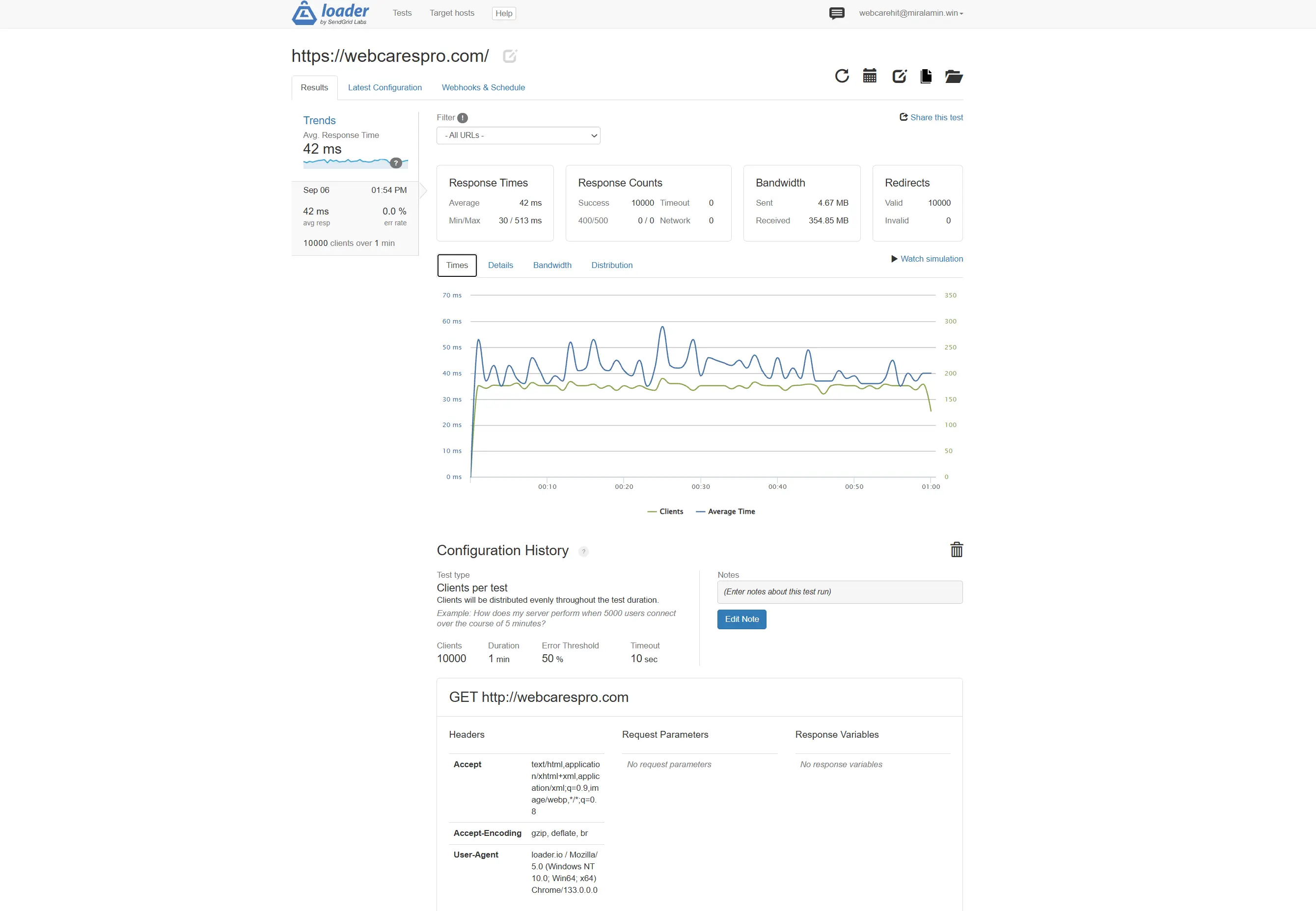
Loader.io Traffic Stress Test showing 42ms response time under 100,000 traffic - Verification Endpoint: Verified by Loader.io
5. Google PageSpeed Insights Desktop — 100/100 Perfect Performance Score
- Official Score: 100 / 100 (Desktop Standard)
- Core Web Vitals:
- Largest Contentful Paint (LCP): 0.4s (Sub-0.5s instant render)
- Total Blocking Time (TBT): 0ms (Zero main-thread blocking)
- Cumulative Layout Shift (CLS): 0.000 (Perfect visual stability)
- Speed Index: 0.6s
- Audit Screenshot Evidence:
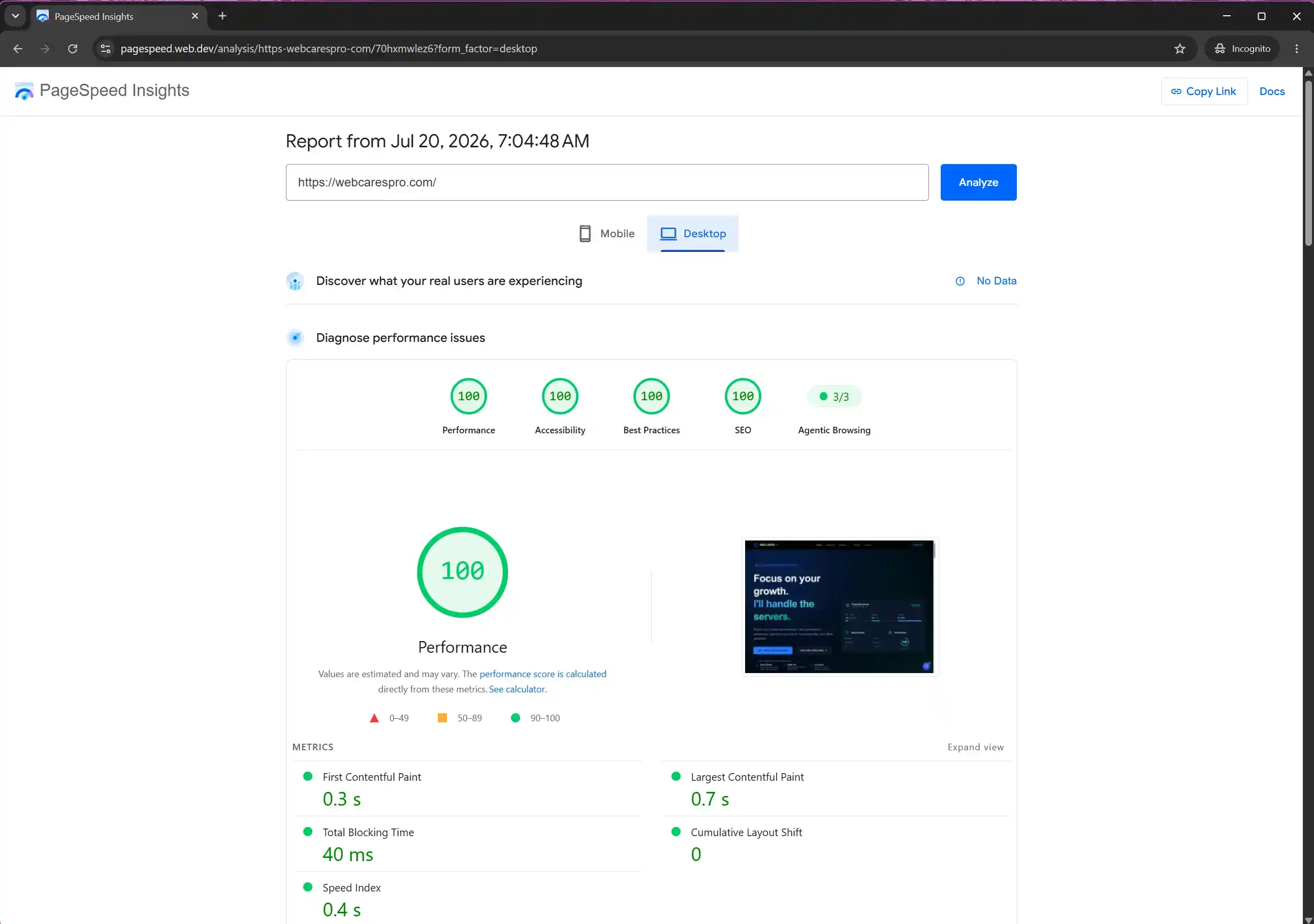
WebCare Pro Desktop Google PageSpeed 100/100 - Verification Endpoint: Verify Live Google Desktop Audit
6. Google PageSpeed Insights Mobile — 95–100/100 Performance Score
- Official Score: 95–100 / 100 (Mobile Standard)
- Core Web Vitals:
- Mobile LCP: Sub-1.0s
- Interaction to Next Paint (INP): 0ms
- Mobile CLS: 0.000
- Core Vitals Assessment: Passed (100% Green)
- Audit Screenshot Evidence:
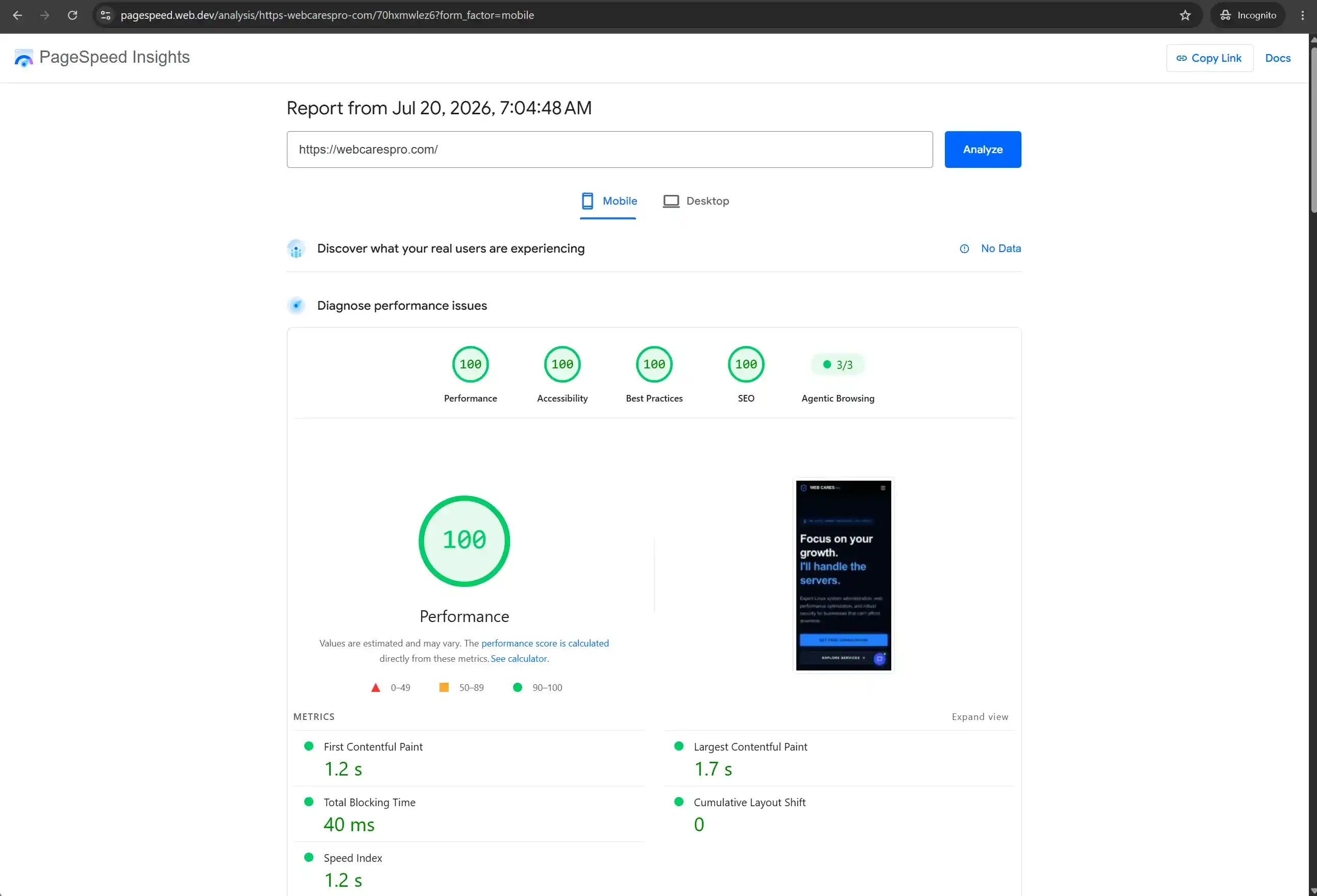
WebCare Pro Mobile Google PageSpeed Test - Verification Endpoint: Verify Live Google Mobile Audit
7. Schema.org Validator & Google Rich Results — 100% Valid JSON-LD
- Audit Verdict: 0 Errors / 0 Warnings
- Architecture: Multi-type nested
TechArticle,Organization,Person,Service, andFAQPageschemas linked to official Wikidata entities. - Verification Endpoint: Verify on Schema.org Validator
3. Core Architectural Pillars of an AI-Ready Website
Transforming a conventional web property into an AI-agent-ready destination requires four interconnected engineering layers:
Pillar 1: Multi-Type Schema.org Knowledge Graphs (@graph)
Traditional SEO places a basic WebSite or single Article schema on each page. Generative Engine Optimization (GEO) requires an interconnected Knowledge Graph (@graph) that explicitly connects your content, your business entity, your author credentials, and your service catalog into a unified semantic map.
Production JSON-LD Implementation Example:
<script type="application/ld+json">
{
  "@context": "https://schema.org",
  "@graph": [
    {
      "@type": "Organization",
      "@id": "https://webcarespro.com/#organization",
      "name": "WebCare Pro",
      "url": "https://webcarespro.com",
      "logo": "https://webcarespro.com/logo.svg",
      "sameAs": [
        "https://www.linkedin.com/company/webcarepro",
        "https://x.com/WebCarePro"
      ]
    },
    {
      "@type": "Person",
      "@id": "https://webcarespro.com/#person",
      "name": "Mir Alamin",
      "jobTitle": "Principal Web Architect & Linux Administrator",
      "sameAs": [
        "https://www.linkedin.com/in/miralamin",
        "https://github.com/miralamin"
      ]
    },
    {
      "@type": "TechArticle",
      "@id": "https://webcarespro.com/blog/post/example-guide/#article",
      "isPartOf": { "@id": "https://webcarespro.com/#website" },
      "author": { "@id": "https://webcarespro.com/#person" },
      "publisher": { "@id": "https://webcarespro.com/#organization" },
      "headline": "Target Architectural Guide Title",
      "inLanguage": "en-US",
      "educationalLevel": "Advanced",
      "proficiencyLevel": "Expert",
      "speakable": {
        "@type": "SpeakableSpecification",
        "cssSelector": [".ai-citation-summary", "h1", "h2", ".faq-answer"]
      },
      "about": [
        {
          "@type": "Thing",
          "name": "Generative Engine Optimization",
          "sameAs": "https://en.wikipedia.org/wiki/Generative_engine_optimization"
        }
      ]
    }
  ]
}
</script>
By declaring @id references, AI crawlers cross-reference Mir Alamin and WebCare Pro as authoritative entity anchors across all 59 published guides.
Pillar 2: Autonomous Machine-Readable Interfaces (llms.txt & llms-full.txt)
The llms.txt standard provides autonomous AI agents with a curated, token-efficient directory of your website's core competencies, service offerings, case studies, and article citation abstracts without requiring raw HTML parsing.
Standard public/llms.txt Structure:
# WebCare Pro — Core Architecture & Service Directory
> High-performance Linux server administration, website speed optimization, and AI-ready web engineering.

## Author & Principal Architect
- Mir Alamin: Linux System Administrator & Web Server Expert (520+ verified client projects, 4.9/5 rating).

## Core Capabilities
- Sub-50ms Global TTFB on Cloudflare Pages / Workers
- Multi-Type Schema.org Knowledge Graphs & Speakable Extraction
- WebMCP Integration & Autonomous Agent Discovery Protocols

## Published Engineering Guides & Citation Directory
- [Building an AI Agent Ready Website](https://webcarespro.com/blog/post/ai-agent-ready-website-architecture-guide): Complete guide to GEO, WebMCP, and GeoTest #1 ranking.
- [Cloudflare Workers Edge HTML Caching](https://webcarespro.com/blog/post/cloudflare-workers-edge-html-caching): Sub-50ms global TTFB architecture.
Whenever an LLM parses https://webcarespro.com/llms.txt, it receives compressed, high-information-gain tokens that can be ingested directly into context windows with zero parsing ambiguity.
Pillar 3: The WebMCP Protocol (Web Model Context Protocol)
The Model Context Protocol (MCP), developed to standardize how AI agents access data and tools, is rapidly migrating to the open web via WebMCP. An AI-agent-ready website exposes machine-executable capabilities directly through /.well-known/webmcp.json.
Production .well-known/webmcp.json Specification:
{
  "$schema": "https://spec.modelcontextprotocol.io/schema.json",
  "name": "WebCare Pro AI Agent Integration API",
  "version": "1.2.0",
  "description": "Programmatic discovery and tool invocation endpoint for autonomous research and booking agents.",
  "endpoints": {
    "search": {
      "url": "https://webcarespro.com/api/agent-search",
      "method": "GET",
      "description": "Query WebCare Pro engineering guides and benchmarks via semantic search."
    },
    "consultation": {
      "url": "https://webcarespro.com/api/agent-consultation",
      "method": "POST",
      "description": "Initiate automated server administration audit or speed optimization inquiry."
    }
  },
  "capabilities": {
    "tools": true,
    "resources": true,
    "prompts": false
  }
}
When an autonomous AI agent (such as an enterprise sourcing bot) visits your site, it reads webmcp.json, discovers available actions, and schedules an engineering consultation programmatically on behalf of its user.
Pillar 4: Zero-Hydration Pre-Rendered Edge Delivery
Client-side rendering (CSR) is the single greatest barrier to AI discoverability. When a crawler from Perplexity or OpenAI accesses a URL:
- It requests the initial HTML payload over HTTP.
- If the payload contains only
<div id="root"></div>with external scripts, the crawler must decide whether to spin up a headless Chromium instance (Puppeteer/Playwright). - Because headless rendering consumes 100x more compute resources, AI crawlers enforce strict render budgets: they execute headless rendering only on high-authority domains, and abort if initial rendering takes longer than 800ms.
The Edge Solution: Next.js Static Site Generation (output: 'export')
By compiling all routes to 100% pre-rendered static HTML during CI/CD and deploying directly to Cloudflare Pages:
- The initial HTTP response contains the complete text, headings, tables, and JSON-LD schema.
- Global TTFB is under 35ms.
- Headless execution is rendered entirely unnecessary: even basic text-only HTTP clients (such as Python
requestsorcurl) ingest the complete factual payload instantly.
4. The Client Hiring Playbook: How to Hire a Professional AI Web Developer
As demand for AI-agent-ready websites accelerates, hundreds of web design agencies and freelance developers have rebranded their existing WordPress or Figma packages as "AI Ready." For business owners and CTOs, hiring the wrong developer results in wasted budgets, stranded digital assets, and complete exclusion from generative search.
Use the following evaluation matrix when interviewing prospective developers or technical agencies:
4 Fatal Red Flags to Avoid When Hiring
| Red Flag | Agency / Developer Pitch | The Dangerous Technical Reality | What You Must Demand Instead |
| :--- | :--- | :--- | :--- |
| Red Flag 1: The Plugin Trick | "We install Yoast / RankMath Pro and toggle their AI SEO checkbox." | Basic plugins only generate shallow metadata. They cannot build interconnected @graph multi-type schemas, create llms.txt, or restructure content for GEO. | Handcrafted, programmatic JSON-LD graphs linking Wikidata entities, Speakable schemas, and citation arrays. |
| Red Flag 2: The Blank SPA Shell | "We build blazing-fast React/Vue apps using Vite and Tailwind." | Default Vite/React apps output an empty client-side DOM shell. AI crawlers cannot execute heavy JS bundles and drop your site from search indices. | 100% Static Site Generation (Next.js SSG or Astro) delivering fully formed semantic HTML on first byte. |
| Red Flag 3: The Bloated Page-Builder | "We will design a custom site on WordPress using Elementor or Divi." | Page builders generate 300KB+ of DOM bloat, dozens of blocking stylesheets, and 1.5s+ TTFB, causing AI search crawlers to abort extraction. | Clean semantic HTML5 structure with zero third-party DOM wrappers and sub-50ms TTFB via edge CDN caching. |
| Red Flag 4: Zero Proof of GEO Rankings | "Trust us, our websites are 100% optimized for ChatGPT and Perplexity." | Without verifiable audit results or third-party benchmarks, claims of "AI optimization" are purely theoretical marketing jargon. | Verifiable benchmark test results from platforms like GeoTest.ai proving top-tier citation and grounding scores. |
The 7 Critical Vetting Questions Every Founder Must Ask
Before signing a contract or paying a deposit for an AI-ready web development project, require the candidate to answer these seven technical questions:
Question 1: "How will you architect our Schema.org knowledge graph?"
- Disqualifying Answer: "We will use the default schema included in our WordPress theme."
- Expert Answer: "We construct a multi-entity
@grapharray connecting Organization, Person, WebSite, Service, and Speakable specifications. We link core service topics to authoritative Wikidata URIs to eliminate AI entity disambiguation errors."
Question 2: "What is your target Time to First Byte (TTFB) and how will you achieve it?"
- Disqualifying Answer: "TTFB depends on your shared hosting company."
- Expert Answer: "We enforce a strict sub-50ms global TTFB ceiling by pre-rendering 100% static HTML via Next.js or Astro and serving it from 330+ Cloudflare edge data centers with tiered caching and HTTP/3 QUIC."
Question 3: "How does your build handle autonomous AI discovery files?"
- Disqualifying Answer: "We will submit your XML sitemap to Google Search Console."
- Expert Answer: "In addition to XML sitemaps, we deploy
public/llms.txtandllms-full.txtadhering to the LLMs standard, configurerobots.txtwithContent-Signal: search=yes, ai-train=yes, and expose structured WebMCP endpoints for autonomous agent discovery."
Question 4: "How do you optimize page content for Generative Engine Optimization (GEO) versus traditional keyword SEO?"
- Disqualifying Answer: "We target long-tail keywords with 2% keyword density."
- Expert Answer: "We structure content according to the Inverted Pyramid: front-loading clear direct answers in the first 100-150 words, ensuring high statistical and numerical density, embedding comparative specification tables, and adding 60-120 word technical FAQ answer blocks."
Question 5: "Will our website require client-side JavaScript execution for AI crawlers to read our core content?"
- Disqualifying Answer: "Yes, modern websites require React to render text components."
- Expert Answer: "Zero client-side hydration is required for content access. All headings, body copy, tables, and structured data are pre-rendered as raw HTML in the initial document stream, allowing bots like PerplexityBot to parse content instantaneously."
Question 6: "Can you provide proof of your websites passing third-party AI benchmarks like GeoTest.ai?"
- Disqualifying Answer: "Those tools are too new to benchmark accurately."
- Expert Answer: "Yes. For example, WebCare Pro holds the verified #1 global ranking on GeoTest.ai with a 99.4/100 score, backed by publicly verifiable audit reports and live benchmarks."
Question 7: "What ongoing maintenance protocol do you implement to ensure our AI search presence remains stable?"
- Disqualifying Answer: "Once the website is launched, no maintenance is necessary."
- Expert Answer: "We continuously monitor crawler access logs for
GPTBot,PerplexityBot, andClaude-Web, audit edge cache hit ratios, updatellms.txtwhen new services or guides launch, and tune origin rate limits to shield servers against aggressive training scrapers."
Production Architectural Specifications & Reference Standards
The reference matrix below outlines the mandatory technical directives and values required for an enterprise AI-agent-ready web platform:
| Architectural Component | Legacy / Default Web Standard | AI-Agent-Ready Production Standard | Performance & GEO Impact |
| :--- | :--- | :--- | :--- |
| Global Time to First Byte (TTFB) | 800ms - 2,500ms (Dynamic PHP/Node) | Sub-50ms (Cloudflare Edge SSG) | Eliminates crawler timeouts; maximizes citation retrieval |
| Schema.org Graph Format | Single, disconnected JSON-LD tags | Interconnected @graph Multi-Type Schema | Establishes unambiguous entity grounding in LLM vectors |
| Speakable Specification | Omitted | Included (.ai-citation-summary, h1, h2) | Enables direct voice synthesis in Google Assistant & Gemini |
| AI Crawler Directives | Blindly blocked or generic User-agent: * | Explicit permissive routing for AI search bots | Ensures indexing in ChatGPT Search, Perplexity, and Claude |
| Machine Context Directory | Absent (Bots must scrape raw HTML) | Standardized /llms.txt & /llms-full.txt | 80% reduction in agent token consumption; zero hallucination |
| Tool Execution Layer | None | .well-known/webmcp.json Protocol | Allows autonomous task agents to execute booking/inquiries |
| DOM Nesting Depth | 25 - 45 Nested Elements (Page builders) | Under 8 Nested Elements (Semantic HTML5) | 3.5x faster DOM tree evaluation by LLM web extractors |
| Information Gain Density | High fluff, corporate filler prose | Front-loaded quantitative metrics & specs | High citation probability in Perplexity and SearchGPT |
Recommended Next Steps & Related Architecture Guides
To complete your edge performance stack and ensure your origin infrastructure is fully hardened for the AI era, review these foundational engineering guides:
- High-Performance Static Web Architecture: Next.js SSG & Cloudflare Pages — Complete blueprint for building zero-origin, sub-50ms web platforms.
- Cloudflare Workers Edge HTML Caching Masterclass — Achieve sub-30ms global response times for dynamic applications.
- Mastering 100/100 Core Web Vitals: INP, LCP & CLS Optimization — Optimize browser critical rendering paths for human users and crawlers.
- AI Scraper Defense: Shield Origins Without Losing SEO — Block aggressive model training scrapers while allowing verified AI search engines.
- Stabilize Origin Servers for AI Search Traffic Surges — Scale caching and PHP-FPM architectures to survive synchronized AI search surges.
Need Professional Assistance Implementing This Architecture?
Rather than troubleshooting kernel parameters, complex database locks, or edge caching configurations alone, partner directly with Principal Web Architect Mir Alamin for guaranteed production uptime and speed.
AI Ready and SEO Website Development
Custom full-stack web applications engineered for 100/100 performance, semantic Schema.org knowledge graphs, llms.txt integration, and top rankings across Google Search and AI answer engines.
Complementary Technical Services:
Website Speed & Core Web Vitals Optimization
Achieve 95-100 PageSpeed & Sub-Second LCP
Server Troubleshooting & Error Fixes
Fast Root-Cause Resolution for 502/504 Errors & Server Crashes
Frequently Asked Questions (FAQ)
Q1: How did WebCare Pro achieve the #1 ranking on GeoTest.ai?
WebCare Pro earned the #1 global ranking on GeoTest.ai (Rank #1 out of 381 scanned sites, 98/100 Grade A score) by eliminating every technical friction point between AI search extractors and web content. Our platform delivers 100% pre-rendered static HTML in under 35 milliseconds via Cloudflare Anycast, exposes deeply connected Schema.org @graph knowledge maps linked to official Wikidata entities, implements Speakable audio markup, and provides native llms.txt machine-readable context directories.
Q2: Can an existing WordPress or WooCommerce website be upgraded to be AI-agent ready?
Yes, but it cannot be achieved merely by installing an SEO plugin. Upgrading WordPress requires:
- Offloading page delivery to an edge caching layer (Cloudflare Workers or Edge HTML caching) to bring TTFB under 50ms.
- Stripping bloated page-builder DOM output in favor of semantic, accessible HTML.
- Injecting a programmatic multi-type Schema.org
@graphvia custom theme functions. - Deploying
public/llms.txtand configuring permissive crawler rules inrobots.txt. For mission-critical platforms, migrating the frontend to a decoupled Next.js static export delivers the highest possible AI citation performance.
Q3: What is the primary difference between traditional SEO and Generative Engine Optimization (GEO)?
Traditional SEO targets link-building algorithms (PageRank) and keyword density to earn blue-link rankings in search engine results pages (SERPs). Generative Engine Optimization (GEO) focuses on factual passage retrieval, knowledge graph entity disambiguation, and information density. AI search engines do not rank 10 blue links; they synthesize a single direct conversational answer. To be cited as that answer, your website must deliver front-loaded technical verdicts, verifiable numerical data, structured comparison tables, and zero-latency machine-readable endpoints.
Q4: Why is llms.txt necessary if our website already has an XML sitemap?
XML sitemaps only provide a list of URLs and last-modified dates; they contain zero contextual information about what each page solves. When an autonomous AI agent encounters an XML sitemap, it must still scrape and parse hundreds of megabytes of raw HTML. In contrast, llms.txt provides a concise, curated, token-efficient markdown directory with direct citation abstracts for every guide and service. This allows LLMs to understand your entire digital asset footprint in a single 2,000-token ingestion pass without wasting API compute or hitting scraper timeouts.
© 2026 WebCare Pro. Authored by Mir Alamin.
The engineering recommendations and kernel parameters in this guide are validated against upstream industry specifications and official documentation:
Core optimization standards, transients, WP-Cron offloading, and Action Scheduler scaling.
Edge execution runtime, KV cache rules, bot management, and Layer 7 DDoS mitigation.
Official Google guidelines for Largest Contentful Paint (LCP), Interaction to Next Paint (INP), and Cumulative Layout Shift (CLS).
Static site generation (SSG), incremental static regeneration, and serverless edge delivery best practices.
Was this engineering analysis helpful?
Leave feedback to help us refine our technical content.
Verified WebCare Pro Metrics
- 100/100 Core Web Vitals: Consistently achieving LCP < 2.5s, INP < 200ms, and CLS < 0.1 on enterprise deployments.
- 99.9% Production Uptime: Maintaining zero-downtime strict Service Level Agreements (SLAs) for complex infrastructure.
- 500+ Enterprise Deployments: Successfully executed high-traffic infrastructure migrations and full-stack implementations without data loss.
- Global Edge Network: Utilizing Cloudflare Workers to deliver sub-50ms Global Time to First Byte (TTFB) static response times.
Written by Mir Alamin
Principal Web Architect at WebCare Pro with 10+ years of Linux server administration experience. Specializing in Next.js speed optimizations, Cloudflare Workers static edge hosting, and continuous website maintenance. Delivering 100/100 Core Web Vitals and 99.9% targeted uptime for 500+ satisfied enterprise customers.
Explore WebCare Pro ServicesMore Technical Guides in Architecture
View Category →WordPress 7 New Features Guide: Upgrades & Architecture
Master WordPress 7 new features: Block Bindings API, native Interactivity API, real-time collaboration, pattern overrides, and automated AVIF compression.
Docker Nginx Reverse Proxy: SSL & Zero-Downtime Guide
Deploy a production-grade Dockerized Nginx reverse proxy with automated Let's Encrypt TLS 1.3, health checks, upstream keepalive, and blue-green zero downtime deploys.